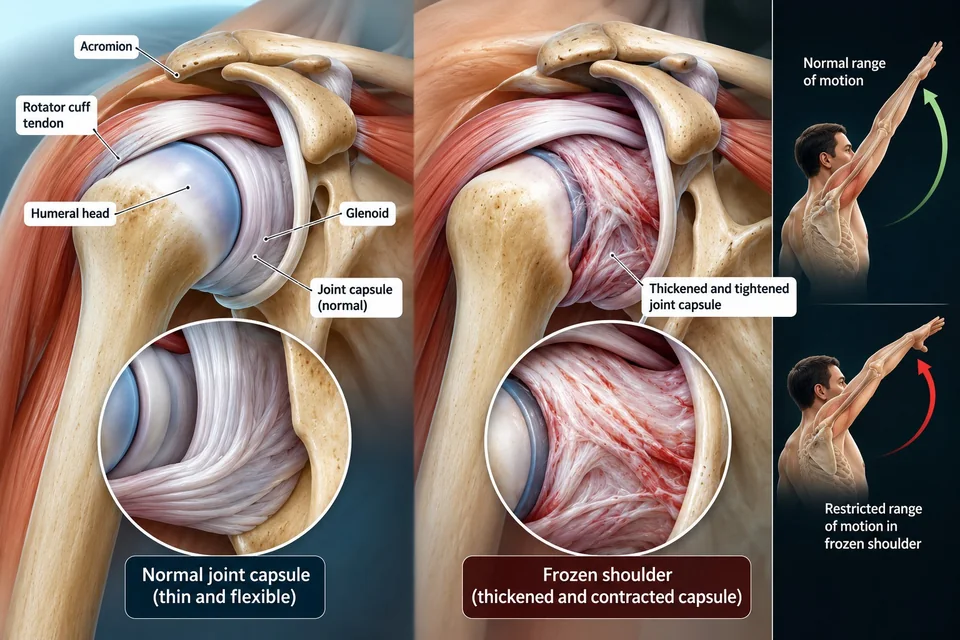
Frozen shoulder can start with a dull ache and gradually make ordinary movements—such as reaching into a cupboard, fastening clothing or sleeping comfortably—more difficult. The medical name is adhesive capsulitis. It involves pain and stiffness around the shoulder joint, with the joint capsule becoming inflamed and tight.
If you are searching for frozen shoulder treatment in Hyderabad, understanding the early signs can help you decide when to seek an assessment. Shoulder pain and stiffness can also arise from rotator-cuff problems, arthritis, neck-related pain and other conditions, so symptoms alone cannot confirm frozen shoulder.
What is frozen shoulder?
The shoulder has a capsule of connective tissue surrounding the joint. In frozen shoulder, this capsule becomes irritated and thickened, then tightens, limiting how freely the shoulder moves. Both active movement (when you move your own arm) and passive movement (when another person gently moves your relaxed arm) may be restricted.
Symptoms often develop gradually and may change over time. Many descriptions use three overlapping phases: a painful phase, a stiff phase, and a gradual recovery phase. Not everyone follows the same timeline, and symptoms can persist for months or longer.
7 signs of frozen shoulder you should not ignore
1. Shoulder pain develops gradually
The discomfort often begins without one clear injury. It may feel like a dull ache around the outer shoulder or upper arm and can become more noticeable over days or weeks. Pain that begins suddenly after a fall, collision or heavy lift needs a different assessment and should not automatically be labelled frozen shoulder.

2. Pain is worse at night
Night pain is common, particularly when lying on the affected side. It may interrupt sleep or make it difficult to find a comfortable position. Try supporting the affected arm with a pillow and avoid forcing the shoulder into a painful position. Persistent night pain should be assessed, especially if it is unexplained or progressively worsening.

3. The shoulder feels increasingly stiff
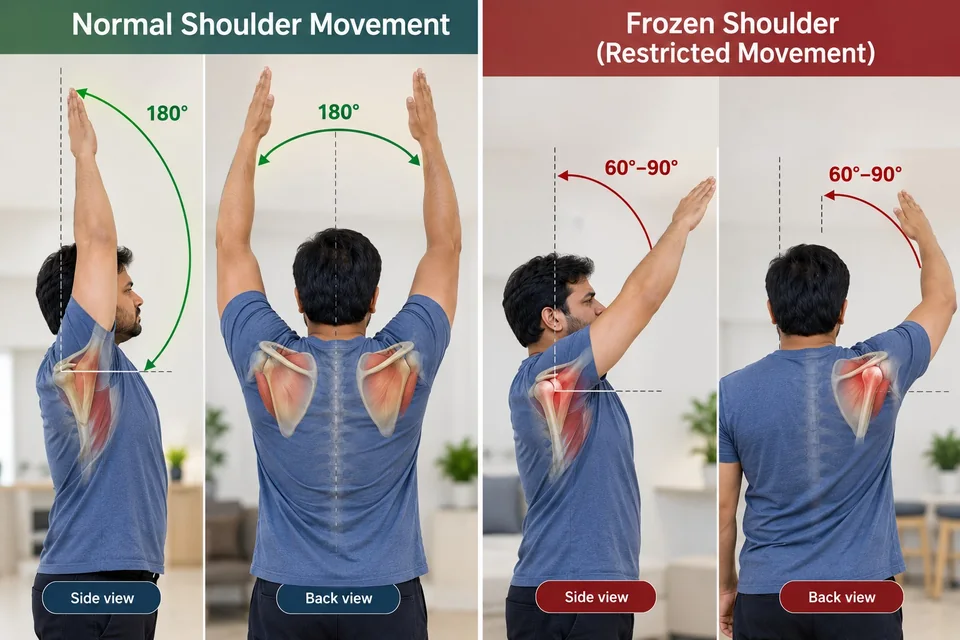
You may notice that the shoulder does not move as freely as it used to. Stiffness can affect several directions, including turning the arm outward, lifting it to the side or reaching behind the body. In frozen shoulder, restricted passive movement is an important examination clue; pain alone does not establish the diagnosis.

4. Raising the arm overhead becomes difficult
Reaching for a shelf, hanging clothes or lifting an object above shoulder level may become harder. Do not use one fixed angle as a diagnostic rule: the amount of movement varies between people and across stages. A clinician should assess the movement pattern and consider other possible causes.

5. Reaching behind your back is difficult
You may struggle to tuck in a shirt, reach a back pocket or fasten clothing behind your body. These movements require shoulder rotation and extension, which may be limited by a stiff joint capsule. Avoid repeatedly forcing the arm behind the back if it produces sharp or escalating pain.

6. Dressing and grooming take more effort
Putting on a shirt or jacket, washing your hair, reaching for a seat belt or carrying out personal-care tasks can become frustrating. These changes are worth mentioning during an assessment because they help the physiotherapist understand how symptoms affect everyday life and which movements matter most to you.

7. Your range of movement keeps decreasing
A key pattern is that the shoulder becomes progressively harder to move, rather than simply hurting during one isolated action. In established frozen shoulder, both self-directed and gently assisted movement may be limited. The degree of restriction differs between individuals, so an illustration showing a specific angle should be treated as an example—not a diagnostic threshold.
Who is more likely to develop frozen shoulder?
Frozen shoulder is more common in adults aged roughly 40–60 and is associated with diabetes and some thyroid disorders. It can also occur after an injury, surgery or a period when the shoulder has been kept still. In many cases, however, there is no single clear cause. Having a risk factor does not mean a person will definitely develop frozen shoulder.
Frozen shoulder or another shoulder problem?
| Feature | May suggest frozen shoulder | Other possible causes |
|---|---|---|
| Onset | Often gradual | May follow injury or repetitive loading |
| Movement | Active and passive movement can both be restricted | Some tendon problems mainly limit active movement because of pain or weakness |
| Rotation | Outward rotation is often notably restricted | Patterns vary by condition |
| Diagnosis | Based on history and examination, with other causes considered | Examination and tests depend on the suspected condition |
This comparison is a general guide, not a self-diagnosis tool. Rotator-cuff disorders, arthritis, fractures and pain referred from the neck can overlap with some symptoms.
How is frozen shoulder diagnosed?
A physiotherapist or doctor will ask about the onset of pain, previous injury or surgery, medical history, sleep and daily activities. The examination may compare active and passive movement, including shoulder elevation and rotation, and assess strength and the neck when appropriate. The clinician will consider other causes of pain and stiffness.
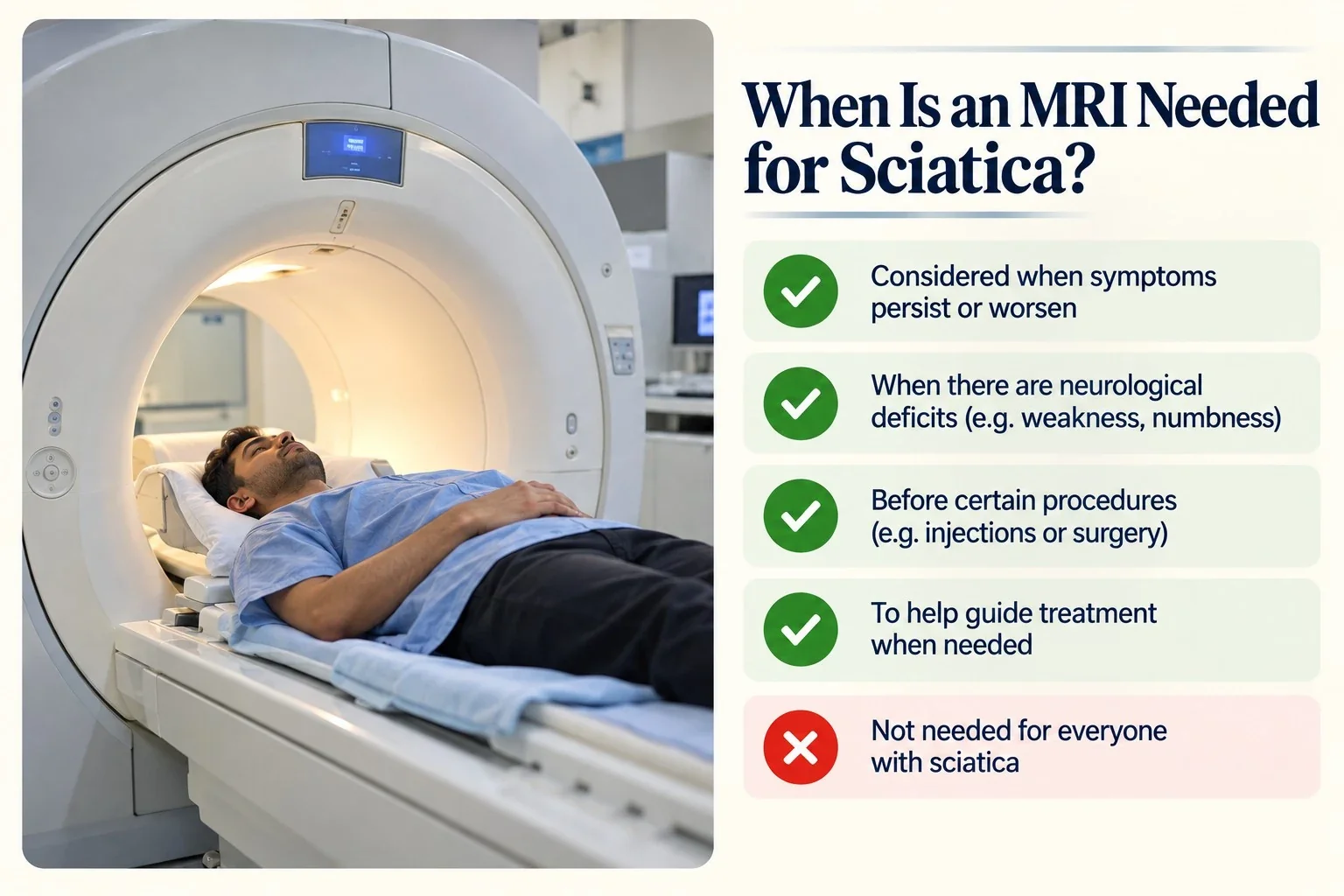
X-rays may be used to look for arthritis or other bony conditions. MRI or ultrasound is not needed for every typical case; imaging may be considered when the history or examination suggests another problem. No single scan should be interpreted in isolation from the clinical assessment.

What does frozen shoulder treatment involve?
Treatment is tailored to the level of pain, stiffness, stage of symptoms, health history and personal goals. There is no single exercise or treatment that suits everyone.
Physiotherapy and graded movement
A physiotherapy plan may include education, comfortable mobility exercises, gradual stretching when appropriate, and exercises to help restore function. The plan should progress according to symptom response. Aggressive stretching or forcing the shoulder through severe pain can aggravate symptoms, particularly during a highly painful phase.
A physiotherapist can assess which movements are restricted, demonstrate appropriate exercises and adjust the intensity over time. Treatment may also include advice on modifying daily tasks and finding more comfortable positions for sleep.

Pain management and medical options
Your clinician may discuss appropriate pain-relief options based on your health history and other medicines. For some people, a doctor may consider a corticosteroid injection into the shoulder joint, particularly when pain is prominent. The potential benefits, risks and suitability should be discussed with the treating clinician. More invasive procedures are generally considered only in selected cases when symptoms remain significantly limiting despite appropriate care.
How long does recovery take?
Recovery varies. Symptoms may improve over many months, and some people experience stiffness for longer. Complete recovery cannot be promised within a fixed number of weeks. Early assessment can help clarify the likely diagnosis, manage pain and create a realistic plan based on your progress.
When should you seek urgent medical care?
Seek urgent assessment after a major injury, if the shoulder looks deformed, or if you have a hot, red or markedly swollen joint with fever. Sudden severe pain or new significant weakness also warrants prompt medical advice. If shoulder pain occurs with chest pressure, breathlessness, sweating, faintness, or pain spreading to the jaw or arm, seek emergency care immediately, as these can be signs of a heart-related emergency.
Frozen shoulder treatment in Hyderabad: local physiotherapy
If shoulder pain and stiffness are affecting sleep, work or daily activities, consider arranging an assessment rather than relying on symptoms alone. Dr Hamid’s Physio and Pain Clinic is based in Manikonda, Hyderabad. An individual assessment can help determine whether the symptoms are consistent with frozen shoulder, identify movements that need attention and guide an appropriate rehabilitation plan.
For people searching online for frozen shoulder physiotherapy near me in Manikonda or shoulder pain physiotherapy in Hyderabad, choose a provider who assesses your symptoms, explains the plan clearly and adapts exercises to your response. Treatment should be individualised rather than based on a standard routine for everyone.
Frequently asked questions
What are the first signs of frozen shoulder?
Early signs commonly include a gradually developing shoulder ache, pain at night and increasing difficulty moving the arm. The pattern varies, and other shoulder conditions can cause similar symptoms.
Can frozen shoulder get better on its own?
It may gradually improve over time, but symptoms can persist for many months or longer. Assessment and an appropriate management plan can help address pain and functional limitations while recovery progresses.
Is frozen shoulder linked to diabetes?
Yes. Frozen shoulder is more common in people with diabetes. Thyroid disorders are also associated with an increased likelihood. These risk factors do not confirm the diagnosis.
Should I exercise if I have frozen shoulder?
Gentle, suitable movement may be helpful, but the type and intensity should match the level of pain and stiffness. Avoid forceful stretching or repeatedly pushing into severe pain. A physiotherapist can help select and progress exercises appropriately.
How long does frozen shoulder take to recover?
There is no fixed timeline. Improvement may take months, and some people have symptoms for longer. Recovery depends on the individual and should not be guaranteed by a particular treatment schedule.
Do I need an MRI for frozen shoulder?
Not always. Diagnosis is often based on the history and physical examination. A clinician may recommend imaging when needed to assess other possible causes.
Where can I get frozen shoulder physiotherapy near Manikonda?
Dr Hamid’s Physio and Pain Clinic is located in Manikonda, Hyderabad. An assessment can help determine the cause of shoulder symptoms and whether physiotherapy is appropriate for your condition.
References and further reading
- NHS: Frozen shoulder
- American Academy of Orthopaedic Surgeons (AAOS): Frozen Shoulder
- Clinical Practice Guidelines for Diagnosis and Non-Surgical Treatment of Primary Frozen Shoulder
- British Elbow and Shoulder Society: Frozen shoulder care pathway
- Indian Journal of Orthopaedics: Frozen shoulder guideline update
This article is for general education and does not replace an individual clinical assessment. Treatment decisions should be based on the person's symptoms, examination and medical history.
Related clinic information
Read about the clinic’s frozen shoulder physiotherapy service or contact the clinic to ask about an assessment.